
Festivals
Festivals of Nigeria
Nigerian festivals mark harvests, river seasons, royal successions and religious calendars. Some draw crowds of hundreds of thousands. These pages cover what happens, who keeps the tradition and roughly when.
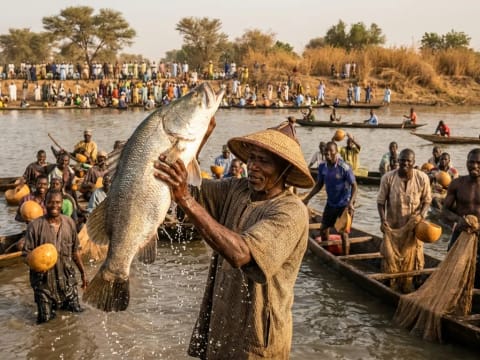
Argungu Fishing Festival
Argungu, Kebbi State, Kebbi
At Argungu in Kebbi State, thousands of men enter a stretch of the Matan Fada river at the same signal, armed only with hand nets and gourds, and have around an hour to catch the largest fish. It is the best-known cultural event in north western Nigeria.
Usually February or March, in the dry season, when the river is low.

Calabar Carnival
Calabar, Cross River State, Cross River
Billed as Africa's biggest street party, the Calabar Carnival runs through December in Cross River State, with costumed bands competing along a twelve-kilometre route. It is a deliberately modern creation rather than an inherited tradition.
December, with the main parades on 26 and 27 December.

Calabar Regatta
Calabar River, Calabar, Cross River
The Calabar Regatta is a boat racing event held on the Calabar River as part of the wider Calabar festival season, in which decorated canoes and boats representing communities, clubs and organisations compete in races watched by large crowds along the riverbanks. Rooted in Calabar's long riverine and maritime trading history, the regatta has become one of the signature events of the annual Calabar festival period, drawing visitors from within Nigeria and abroad to the city's December celebrations.
December, as part of the Calabar festival season, with the exact date set by festival organisers each year

Durbar
Kano, Katsina, Zaria, Bida, Sokoto and other emirate capitals, Kano
Durbar is the mounted procession held in the northern emirates at the two Eid festivals, in which cavalry in full regalia parade before the emir and salute him at a gallop. Kano, Katsina, Zaria, Bida and Sokoto hold the largest.
The days following Eid al-Fitr and Eid al-Adha, and occasionally for the installation of an emir.

Egungun
towns across Yorubaland, including Oyo and Abeokuta, Oyo
Egungun is the Yoruba masquerade tradition through which communities honour and commemorate their ancestors, with masked and richly costumed performers appearing in public during annual festivals held in towns across Yorubaland. Each masquerade is dressed in layered, often colourful cloth that conceals the identity of the performer, and their public appearances combine dance, music and blessing of the community. Egungun festivals remain a living part of Yoruba cultural and spiritual life, observed in towns such as Oyo, Abeokuta and many others, each with its own local calendar and variations in practice.
varies by town, with each community's traditional council setting its own annual dates
Ekpe
Calabar and Cross River communities, Cross River
Ekpe is a longstanding Efik and wider Cross River institution associated with leadership, social order and the Nsibidi system of symbols, whose public face is seen through masked performances that appear at festivals, funerals of titled members and important community occasions. The Ekpe masquerade, recognisable by its costume and distinctive movements, performs in public squares accompanied by drumming and its own set of sounds and gestures, while much of the institution's internal governance and knowledge remains the preserve of its titled membership.
at title-taking ceremonies, funerals of titled members and festival occasions through the year, with no single fixed festival date
Ekpo
communities across Akwa Ibom State, Akwa Ibom
Ekpo is a masquerade tradition of the Ibibio people of Akwa Ibom State, associated with an ancestral society that upholds social order, honours the dead and performs at funerals, festivals and seasonal observances. Ekpo masquerades, distinguished by their carved wooden masks and dark, textured costumes, appear in public performances that combine dance, drumming and symbolic display, representing ancestral spirits returning to interact with the living community. The tradition remains an active part of Ibibio cultural and ceremonial life, particularly in the dry season when masquerade seasons and burial ceremonies are most common.
performed through the year at funerals and community events, with the fullest masquerade seasons concentrated in the dry season (roughly November to March)
Eyo Festival
Lagos Island, Lagos State, Lagos
The Eyo is a Lagos Island procession of masquerades dressed entirely in white, carrying staffs and moving through closed streets in honour of a departed oba or chief. It is held rarely and never on a fixed calendar, which is part of what makes it an event.
Irregular. It is declared for a specific occasion, usually the final burial rites of a Lagos oba or a senior chief, and announced weeks in advance.
Igue
Benin City, Edo
Igue is the annual festival of the Benin monarchy, held at the Oba's palace in Benin City, in which the Oba renews his spiritual authority and blesses his kingdom for the coming year. It combines private royal rites with public celebration, including chiefs' homage, cultural displays and feasting across Benin households. Igue is regarded as the climax of the Benin ceremonial calendar, drawing chiefs, title-holders and members of the Edo diaspora who return home to mark the season with their families and to witness the Oba's public appearances.
late December, in the days leading up to the New Year, with exact palace dates fixed by the Benin traditional council each year
Ijele
Anambra communities, Anambra
Ijele is the largest and most elaborate of the Igbo masquerades, a towering, multi-tiered structure of cloth and ornament that can stand several metres high, associated with the Anambra area and traditionally brought out only on the most significant occasions, such as the funeral of a titled elder or a major community celebration. Because of its size, cost and ceremonial importance, Ijele appears far less often than smaller masquerades, and its rare public outings draw very large crowds. UNESCO has recognised Ijele masquerade as part of the Intangible Cultural Heritage of Humanity.
on rare occasions tied to significant funerals or community events, with no fixed annual date
Iri Ji
communities across Igboland, Anambra
Iri Ji, the Igbo new yam festival, marks the end of the farming year and the first harvest of yam, the staple crop long central to Igbo food and identity. Celebrated across Igbo communities under various local names, it combines thanksgiving to the earth and ancestors with feasting, cultural displays and family reunions. Because it is tied to the harvest rather than a single fixed calendar, different towns and villages hold their own Iri Ji on dates set by local custom, though most fall within the same general season.
August or September, around the yam harvest, though each community fixes its own date
Kwagh-hir
communities across Benue State, particularly among Tiv troupes, Benue
Kwagh-hir is a Tiv puppet theatre tradition from Benue State, combining carved and constructed puppets, masks, storytelling, music and dance into travelling night-time performances. Troupes stage narrative sketches that draw on folklore, satire and everyday Tiv life, often using mechanised or manipulated puppet figures to depict animals, spirits and human characters. Recognised internationally, Kwagh-hir was inscribed on UNESCO's Representative List of the Intangible Cultural Heritage of Humanity, and it continues to be performed by community troupes at festivals, competitions and cultural events across Tivland.
performed through the year at community events, with major troupe competitions organised periodically by cultural festivals in Benue State; no single fixed annual date applies
Leboku
Ugep, Cross River
Leboku is the new yam festival of the Yakurr people, celebrated at Ugep in Cross River State, marking the first harvest of yam and giving thanks for a successful farming season. It is one of the most prominent new yam festivals in southern Nigeria, combining ritual thanksgiving with cultural displays, wrestling and traditional dance, and it draws large numbers of visitors, indigenes living elsewhere in Nigeria, and members of the Yakurr diaspora who return to Ugep for the occasion.
August, with the exact dates set by the Yakurr traditional council each year
Lisabi
Abeokuta, Ogun
Lisabi Festival is an Egba cultural celebration held at Abeokuta in Ogun State, honouring Lisabi Agbongbo-Akala, the legendary strongman and organiser credited with liberating the Egba people from Oyo overlordship and uniting the scattered Egba townships into the confederacy that later settled at Abeokuta. The festival combines historical re-enactment, traditional worship, cultural displays and civic pageantry, drawing Egba indigenes, the Alake and other obas, and diaspora descendants to mark communal identity and the founding legacy that Lisabi represents for Egbaland.
held annually, usually around September; the exact date is set by the Egba traditional council each year
Mmanwu
towns across Igboland, including Awka, Anambra
Mmanwu is the Igbo masquerade tradition, encompassing a wide range of masked spirit performers who appear at festivals, funerals of titled elders and other important community occasions across Igboland. Masquerades vary greatly by community and society, from towering figures such as Ijele to smaller, agile performers known for acrobatics and satire, and each carries its own costume, character and set of movements. Mmanwu remains a prominent and visible part of Igbo cultural life, with masquerade festivals in towns such as Awka, Onitsha and many others drawing large public audiences.
varies by town, with dates set by local masquerade societies and traditional councils
New Yam Festival
Across the south east and the Middle Belt, with each town keeping its own date, Enugu
Iri ji, the new yam festival, marks the end of the farming cycle and the point at which the season's yams may be eaten. No one eats the new crop before the ceremony. It is the most important date in the Igbo year and is kept in related forms by many other Nigerian peoples.
August and September, varying by community, at the end of the rainy-season harvest.
Nwonyo Fishing Festival
Nwonyo Lake, near Ibi, Taraba
The Nwonyo Fishing Festival is a communal fishing competition held on the Nwonyo Lake near Ibi in Taraba State, drawing fishermen and spectators from across the region for a day of open-water fishing contests, boat displays and cultural entertainment. Rooted in the fishing traditions of communities along the Benue River system, the festival has grown into a wider cultural and tourism event, with cash prizes for the largest catches and performances by traditional dance and masquerade groups from the area.
during the dry season, on a date set by the local organising committee each year
Ofala
Onitsha, Anambra
Ofala is the ceremonial outing of an Igbo obi (king), in which the monarch appears in full regalia before his people to reaffirm the bond between throne and community. The most widely known Ofala is that of the Obi of Onitsha, though other Igbo monarchies hold their own versions of the ceremony. The festival features royal dancing, the display of ancestral regalia and beadwork, and the paying of homage by chiefs, titled men and townspeople, and it draws large crowds of Onitsha indigenes and visitors each year.
typically October, with the exact date fixed by the palace each year
Ogun Festival
various Yoruba towns, notably Ire-Ekiti and Ondo, Ondo
Ogun Festival is the Yoruba celebration of Ogun, the orisa of iron, war and technology, patron of blacksmiths, hunters, warriors and all who work with metal. It is observed independently in numerous Yoruba towns rather than on a single fixed occasion, with Ire-Ekiti and Ondo among the towns most closely associated with major observances, each community setting its own dates through its traditional and priestly authorities. The festival honours Ogun's role as a pathfinder and protector, and typically brings together hunters' guilds, blacksmiths, chiefs and worshippers in rites, processions and communal feasting.
observed annually by individual towns, each setting its own date through local tradition; Ire-Ekiti and Ondo hold their own separate Ogun festivals rather than a single shared date
Ojude Oba
Ijebu-Ode, Ogun
Ojude Oba, meaning 'the King's forecourt', is a homage festival held at Ijebu-Ode in Ogun State, in which age-grade regalia societies, market women's associations and horsemen parade before the Awujale of Ijebuland. It began as a Muslim community's way of paying homage to the traditional ruler after Eid celebrations and has grown into one of Yorubaland's most colourful public gatherings, drawing thousands of visitors, diaspora returnees and photographers who document its elaborate dress, horses and displays of family and communal pride.
the third day after the Ileya (Eid el-Kabir) holiday, so the date moves each year with the Islamic calendar
Olojo
Ile-Ife, Osun
Olojo Festival is Ile-Ife's most sacred annual observance, centred on Ogun, the orisa of iron, and on the rare public appearance of the Ooni of Ife wearing the Aare crown, believed to be one of the oldest and most powerful crowns in Yorubaland. Regarded by many as the festival marking the day the Yoruba god Oduduwa descended to create the earth at Ile-Ife, Olojo draws worshippers, traditional rulers, chiefs and visitors from across Yorubaland and the diaspora to witness the Ooni's procession, the veneration of Ogun and the wider cultural events that surround it.
held annually in the Yoruba traditional calendar, usually falling around October; the date is fixed by the Ife traditional council and Ifa priests each year and shifts accordingly
Osun Osogbo Festival
Osogbo and the Osun-Osogbo Sacred Grove, Osun State, Osun
A two-week annual festival in Osogbo honouring Osun, the Yoruba goddess of the river, fertility and prosperity, culminating in a procession to her grove on the riverbank. The Osun-Osogbo Sacred Grove is a UNESCO World Heritage Site.
August each year, over roughly two weeks.
Pategi Regatta
Pategi, on the River Niger, Kwara
Pategi Regatta is a Nupe river festival held on the River Niger at Pategi in Kwara State, built around canoe races, swimming displays and traditional water-based performances. Organised with the support of the Etsu (traditional ruler) of Pategi and local government authorities, the regatta draws communities from along the river, visitors from across Nigeria and international tourists to watch competitive boat racing alongside cultural displays, wrestling and horse riding, celebrating Nupe riverine heritage and the community's long relationship with the Niger.
held annually, typically around March or April; the exact date is set each year by the Pategi traditional council and local organisers
Sango Festival
Oyo town, Oyo
The Sango Festival honours Sango, the Yoruba orisa of thunder and lightning and a historic Alaafin of Oyo, and is celebrated chiefly at Oyo town, the seat of his worship. Devotees, priests and priestesses of Sango gather at his shrines to perform music, dance and offerings that recall his power and legend. The festival remains a living religious observance for adherents of the Yoruba orisa tradition and has also become a cultural tourism event, attended by visitors, researchers and members of the Yoruba diaspora who maintain Sango worship abroad.
August, though the exact dates are set by the Sango priesthood and Oyo traditional council each year
Sharo
communities across Adamawa State, Adamawa
Sharo is a Fulani rite of passage in which young men undergo a public flogging ordeal to demonstrate courage, endurance and readiness for adulthood and marriage. Practised among Fulani communities in parts of northern Nigeria, it is performed before an audience of family, age-mates and prospective in-laws, accompanied by music and praise-singing. The event is a significant social occasion in Fulani pastoral communities, marking a young man's transition to manhood and his standing within the community, rather than a punitive or purely violent spectacle.
during the dry season, at gatherings whose specific dates are set by local Fulani communities