
Overview
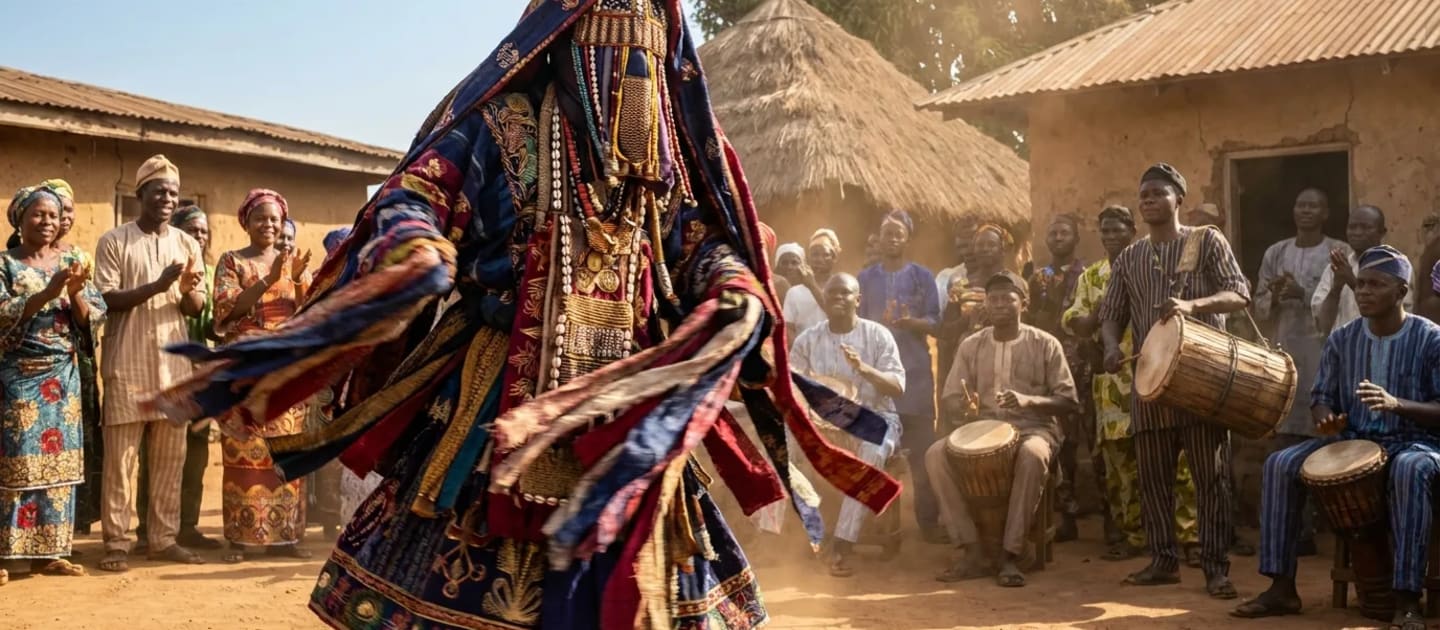
Egungun is the Yoruba masquerade tradition through which communities honour and commemorate their ancestors, with masked and richly costumed performers appearing in public during annual festivals held in towns across Yorubaland. Each masquerade is dressed in layered, often colourful cloth that conceals the identity of the performer, and their public appearances combine dance, music and blessing of the community. Egungun festivals remain a living part of Yoruba cultural and spiritual life, observed in towns such as Oyo, Abeokuta and many others, each with its own local calendar and variations in practice.
History and origin
Egungun masquerade practice is rooted in the Yoruba belief that ancestors continue to take an active interest in the affairs of the living and can be honoured and consulted through masked representation during annual festivals. Individual lineages and masquerade houses (egungun compounds) have traditionally maintained their own masquerades, costumes and performance styles, passed down through generations of custodianship within particular families or quarters of a town. Yoruba towns have long held annual Egungun festivals as fixed points in the ritual calendar, and the tradition has continued through significant social change, remaining an important marker of lineage identity and communal continuity in many Yoruba communities today.
What happens
During an Egungun festival, masquerades emerge from their family compounds or shrines, dressed in elaborate layered costumes of cloth, often with the accompaniment of drummers and praise-singers who announce their arrival. The masquerades parade through the streets and public squares of the town, dancing and performing movements distinctive to each masquerade's character, while onlookers gather to watch, and in some traditions maintain a respectful distance as the masquerades pass. Blessings are given to households and individuals along the route, and some masquerades perform acrobatic or theatrical displays that draw crowds. The festival typically involves a sequence of appearances by different lineage masquerades over one or more days, concluding with the masquerades returning to their compounds.
When it takes place
varies by town, with each community's traditional council setting its own annual dates
Where a date is set by a traditional council, a lunar calendar or the harvest, it changes from year to year. Confirm locally before making plans around it.
Where to see it
towns across Yorubaland, including Oyo and Abeokuta, Oyo State
The people behind it
YorubaThe Yoruba are concentrated in south western Nigeria, across Lagos, Ogun, Oyo, Osun, Ondo and Ekiti, with large populations in Kwara and Kogi and related communities in Benin Republic and Togo. They are one of the most urbanised peoples in Africa, with towns such as Ibadan, Abeokuta, Ile-Ife, Oyo and Ogbomoso that were already large and densely built long before colonial rule. Yoruba political tradition is monarchical: each town has an oba supported by a council of chiefs, and Ile-Ife holds the place of origin in Yoruba thought, while the Alaafin of Oyo once headed an empire that stretched west into present-day Benin. Yoruba religion, philosophy and art have travelled further than the people themselves. The òrìṣà tradition, the Ifá divination corpus and the drumming and dance that accompany them survive in Cuba, Brazil and Trinidad through the Atlantic slave trade, where they shaped Santería and Candomblé. Today most Yoruba are Muslim or Christian, often within families that hold both, and older practice persists alongside them. The language is tonal, written in a Latin alphabet with diacritics, and carries a proverb-heavy register in which indirect speech and respect for age are woven into ordinary conversation.Spotted something wrong? Tell us.