
Overview
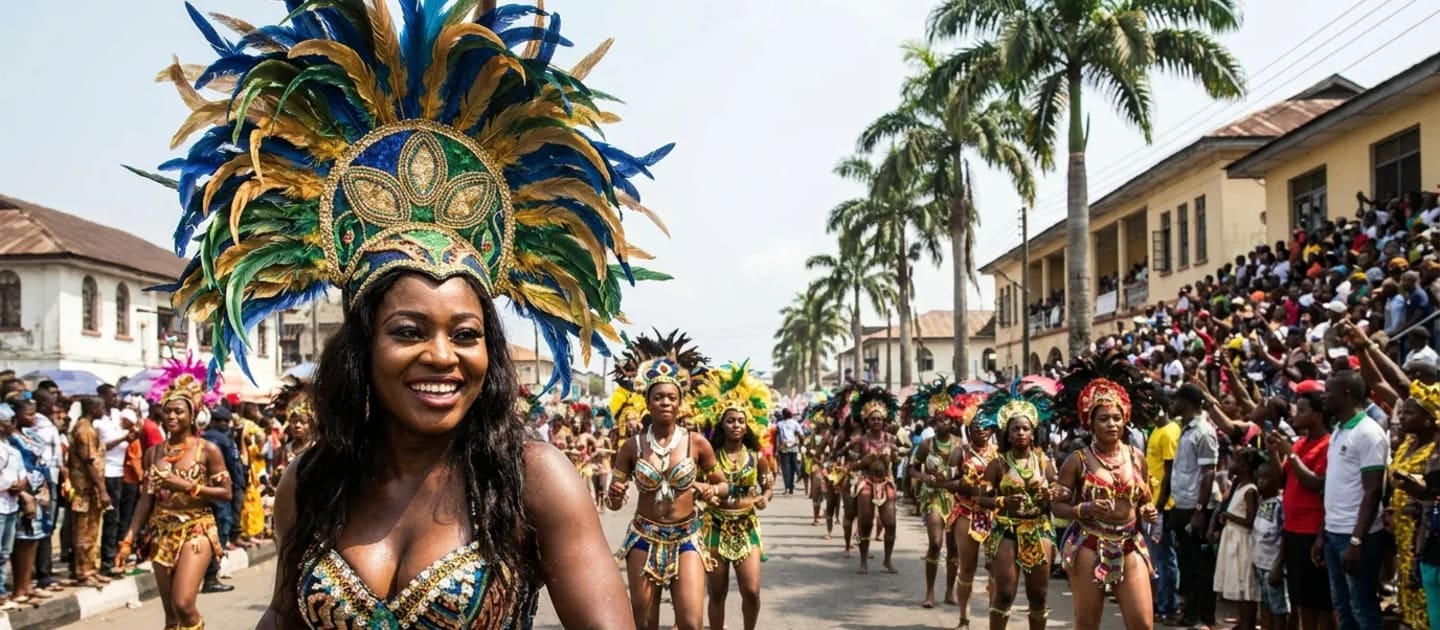
Billed as Africa's biggest street party, the Calabar Carnival runs through December in Cross River State, with costumed bands competing along a twelve-kilometre route. It is a deliberately modern creation rather than an inherited tradition.
History and origin
The carnival was launched in 2004 by the Cross River State government under Donald Duke as the centrepiece of a month-long festival intended to build a tourism economy for the state. It draws on Caribbean carnival formats and on local Efik and Ejagham masquerade traditions, including the Ekpe and Ekpo societies, and has grown into one of the largest organised events in Nigeria.
What happens
Five main competing bands — Passion 4, Seagull, Bayside, Freedom and Masta Blasta — spend months preparing costumes and choreography around an announced annual theme, then parade the carnival route before judges and crowds. Around the main parade there is a Carnival Dry Run, a children's carnival, an international segment with visiting troupes, a Christmas village, boat regattas and concerts. The wider Calabar Festival runs for most of December.
When it takes place
December, with the main parades on 26 and 27 December.
Where a date is set by a traditional council, a lunar calendar or the harvest, it changes from year to year. Confirm locally before making plans around it.
Where to see it
Calabar, Cross River State, Cross River State
The people behind it
IbibioThe Ibibio are the majority people of Akwa Ibom State, closely related to, but distinct from, the neighbouring Annang, Oron and Efik peoples, with whom they share deep linguistic and cultural ties in the Ibibio-Efik cluster. They speak Ibibio, a Benue-Congo language of the Lower Cross group. Farming, particularly of oil palm, yam and cassava, has long underpinned the economy of the forest belt behind Calabar, and Ibibio communities have historically been organised through village councils of elders working alongside Ekpe, a graded men's society with judicial and ritual authority. Ibibio carving and masquerade, especially the Ekpo tradition, are held in museum collections worldwide. Christianity, introduced through nineteenth-century mission stations at Calabar and Uyo, is now the dominant religion, though elements of traditional belief and practice persist.Spotted something wrong? Tell us.