
Overview
Zamfara State lies in Nigeria's far north west, with Gusau as its capital. Created in 1996 from part of Sokoto State, it is bordered by Sokoto, Katsina, Kaduna and Niger States and shares an international boundary with Niger Republic. The state's population is predominantly Hausa, with Fulani communities also present, and Islam is the dominant religion, shaping daily life and law alike. Zamfara is best known nationally as the first Nigerian state to adopt sharia criminal law, in 1999. Its economy rests substantially on agriculture and artisanal gold mining, the latter bringing both economic opportunity and serious environmental and security challenges in recent years.
History
The Zamfara kingdom was a significant Hausa state from at least the sixteenth century, historically noted for its cavalry and rivalry with neighbouring Kebbi and Gobir. It was conquered during the Sokoto jihad led by Usman dan Fodio in the early nineteenth century and absorbed into the Sokoto Caliphate as an emirate, a status broadly continued under British colonial indirect rule. After independence, the Zamfara area remained part of Sokoto State until 1 October 1996, when the military government of General Sani Abacha created Zamfara State as a separate entity with Gusau as capital. In 1999, under Governor Ahmad Sani Yerima, Zamfara became the first Nigerian state to introduce sharia criminal law, prompting similar moves across other northern states.
Geography
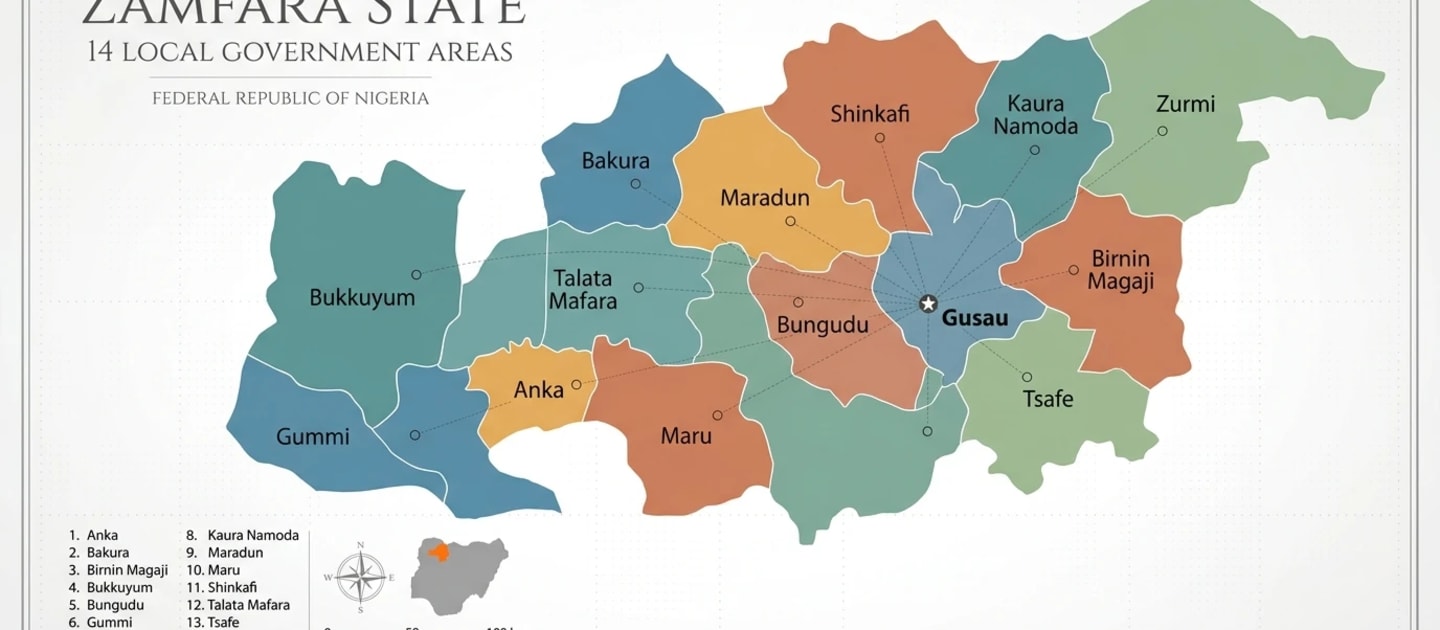
Zamfara State covers an area of Sudan savannah in Nigeria's north west, characterised by generally flat to gently undulating terrain with seasonal rivers, notably tributaries feeding into the Sokoto River system. The climate is markedly seasonal, with a short rainy season and a long dry season influenced by the harmattan wind. The state comprises 14 local government areas, with Gusau as its capital and largest urban centre; other significant towns include Kaura Namoda, Talata Mafara and Anka. Vegetation supports both crop farming and livestock grazing, though desertification pressure affects the state's northern reaches.
Economy
Agriculture underpins the Zamfara economy, with farmers growing millet, sorghum, maize, rice, groundnuts and cotton, alongside significant livestock rearing. The state also holds substantial artisanal and small-scale gold deposits, particularly around Anka and Bukkuyum, and gold mining has grown into an important, if largely informal, economic activity. This mining activity, however, was linked to a severe lead poisoning outbreak beginning in 2010, caused by lead-contaminated ore being processed in and around residential areas, which killed several hundred people, mostly young children, and prompted a major international public health and remediation response. Trade and small-scale manufacturing also contribute to the state's economy.
Next from Zamfara: read about the Hausa who live here.
Landmarks
Kwatarkwashi Hills
A hilly area in southern Zamfara historically valued for its defensive terrain and rock formations.
Gusau Central Mosque
A major mosque in the state capital reflecting Zamfara's predominant Islamic identity.
Peoples of Zamfara
Languages spoken
Culture and custom
More from North West
Spotted something wrong? Tell us.