
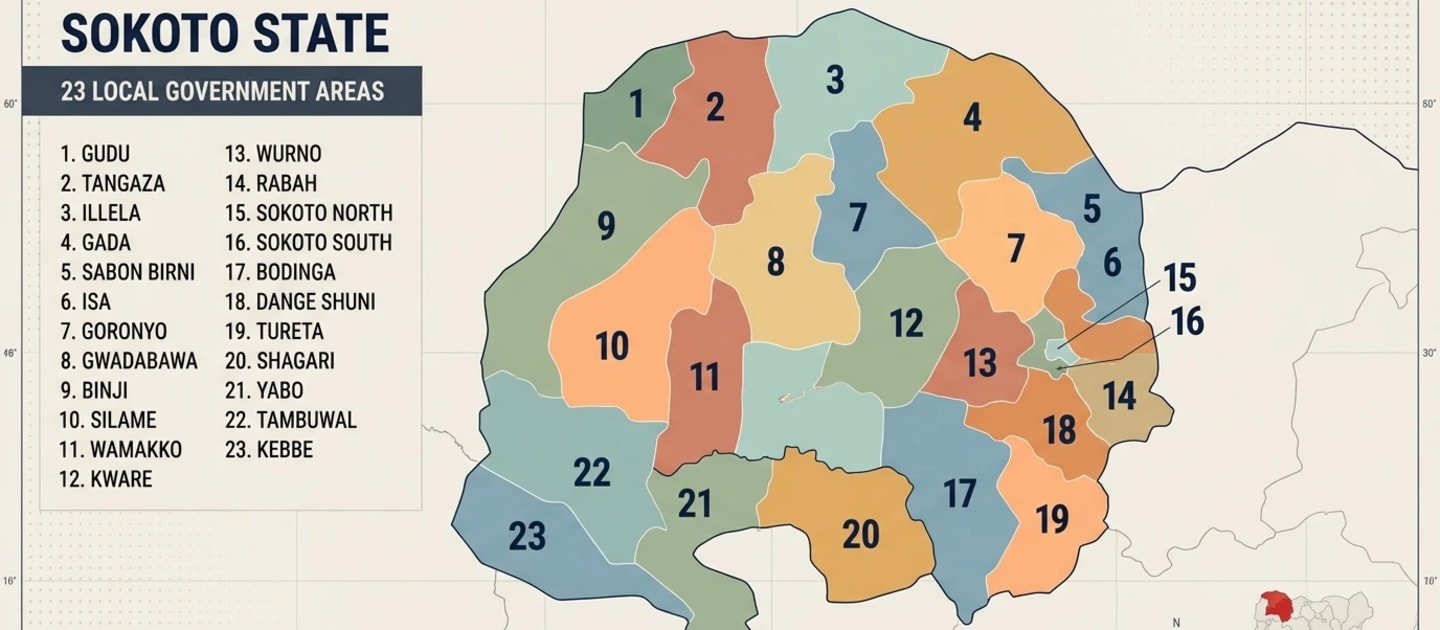
Overview
Sokoto is a north-western Nigerian state on the border with Niger Republic, predominantly Hausa-Fulani and Muslim, and holds a unique place in Nigerian history as the seat of the Sultan of Sokoto, spiritual leader of the country's Muslim community and traditional head of the former Sokoto Caliphate. Sokoto city, the state capital, grew as the caliphate's political and religious centre after its founding in the early nineteenth century and remains a major centre of Islamic scholarship. The state's nickname, Seat of the Caliphate, reflects this heritage. Sokoto's economy and social life remain closely tied to its role as a historic and continuing religious centre, alongside farming and livestock rearing across its arid landscape.
History
In 1804 Usman dan Fodio launched a jihad against the Hausa states, and by 1809 his forces had established Sokoto as the capital of the Sokoto Caliphate, which grew to encompass dozens of emirates across much of what is now northern Nigeria and parts of neighbouring countries, becoming one of the largest states in nineteenth-century Africa. Usman dan Fodio's son, Muhammadu Bello, consolidated the caliphate from Sokoto, and the title of Sultan of Sokoto continued as the caliphate's spiritual and political leadership. The British defeated the caliphate's forces in 1903 and administered Sokoto within Northern Nigeria under indirect rule, retaining the Sultanate as a religious and traditional institution. Sokoto State was created on 3 February 1976, later losing territory to the creation of Kebbi State in 1991 and Zamfara State in 1996. The Sultan of Sokoto remains Nigeria's foremost Islamic traditional ruler.
Geography
Sokoto State lies at the edge of the Sahel, one of the hottest and driest parts of Nigeria, with flat to gently undulating terrain and sandy soils. The Rima and Sokoto rivers cross the state and join the Niger system, supporting irrigation farming along their floodplains through schemes such as the Bakolori and Goronyo dams. Rainfall is low, generally under 700mm a year, concentrated between June and September, followed by a long, intensely hot dry season and strong Harmattan winds from November to February. Vegetation is Sahel and Sudan savanna, sparse in the drier northern parts of the state. Desertification and periodic drought are significant long-standing environmental challenges.
Economy
Sokoto's economy rests on agriculture and livestock, with millet, sorghum, cowpeas, onions and irrigated rice and wheat grown through schemes fed by the Rima and Sokoto rivers, including the Bakolori and Goronyo dam projects. The state is a major centre for livestock trade, particularly cattle, sheep, goats and camels, reflecting its Fulani pastoralist traditions. Sokoto city serves as a religious, educational and commercial hub, drawing visitors and scholars connected to the Sultanate and its associated Islamic institutions, including Usmanu Danfodiyo University. Leatherworking and tanning have a long tradition in the state. Cross-border trade with Niger Republic also contributes to the local economy.
Next from Sokoto: read about the Hausa who live here, or try the food, starting with Miyan Taushe.
Landmarks
Sultan of Sokoto's Palace
The historic palace of the Sultan of Sokoto, spiritual leader of Nigeria's Muslim community and seat of the former caliphate's leadership.
Sokoto Central Mosque
A major mosque in Sokoto city associated with the city's role as a centre of Islamic scholarship.
Hubbare (Tomb of Usman dan Fodio)
The resting place of Usman dan Fodio, founder of the Sokoto Caliphate, revered as a site of religious significance.
Peoples of Sokoto
Languages spoken
Food from Sokoto
- Miyan Taushesoup
Miyan Taushe is a Hausa pumpkin soup made using the flesh of a squash-like pumpkin (kabewa) cooked down with ground melon or groundnut, vegetables and often dried fish or meat. It has a thick, mildly sweet base from the pumpkin and is a common everyday soup in northern Nigerian homes.
Culture and custom
More from North West
Spotted something wrong? Tell us.