
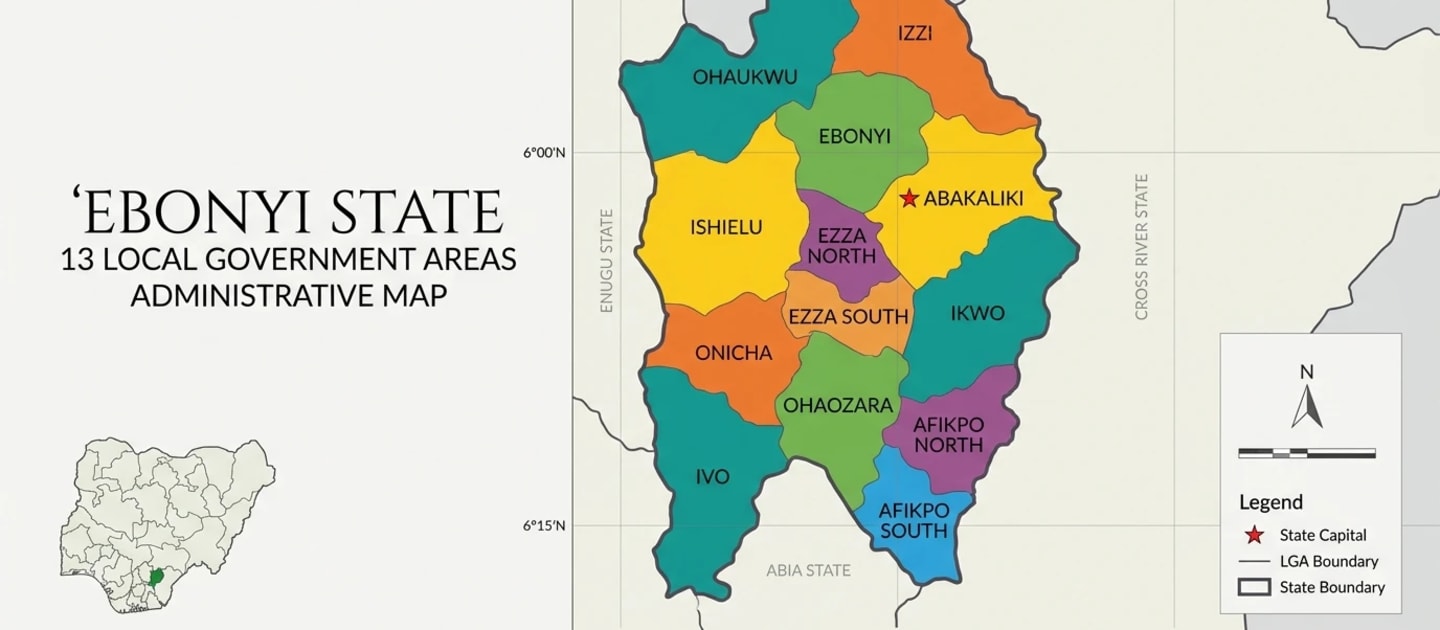
Overview
Ebonyi State, in Nigeria's South East, was created on 1 October 1996 from parts of Enugu and Abia States, with Abakaliki as its capital. Its name derives from the Ebonyi River, and its nickname, "Salt of the Nation", refers to the natural salt lakes at Okposi and Uburu that have long attracted traders from across the region. Ebonyi is one of the newer and less urbanised South East states, with an economy still heavily weighted towards agriculture, particularly rice cultivation, which has earned Abakaliki the informal title of a leading rice-producing centre in Nigeria. The population is Igbo-speaking, though with distinct dialectal variation, and the state retains strong rural and communal traditions alongside its administrative institutions.
History
The territory now forming Ebonyi State was historically home to numerous autonomous Igbo communities, including groups around Abakaliki, Afikpo and the Ezza, Izzi and Ikwo peoples, organised around village-group and clan structures rather than centralised kingdoms. The salt lakes at Okposi and Uburu were significant pre-colonial trade resources, drawing traders from across the wider Igbo hinterland and beyond in exchange for salt. Under colonial rule the area was administered within Ogoja and Abakaliki provinces of the Eastern Region. After independence it was successively part of the East Central State, then Anambra and Imo States following the 1976 state creation exercises. Ebonyi State was formally created on 1 October 1996 under General Sani Abacha's administration, carved from parts of Enugu and Abia States, with Abakaliki designated as its capital.
Geography
Ebonyi State lies in a transition zone between the rainforest of the South East and the savanna further north, giving it a mixed vegetation cover. The Ebonyi River and the Cross River system drain parts of the state, and the ancient salt lakes at Okposi and Uburu are a distinctive hydrological feature. The terrain includes low hills and escarpments, notably around Ishiagu and Ezillo, alongside extensive lowland plains suited to rice farming, particularly in flood-prone areas. Rainfall follows the typical wet season pattern from April to October. The state experiences soil erosion in parts of its terrain and seasonal flooding along river floodplains, which, while occasionally damaging to settlements, also renews the fertile land used for its extensive rice cultivation.
Economy
Agriculture dominates Ebonyi's economy, with the state widely recognised as one of Nigeria's leading producers of rice, grown extensively in the floodplains around Abakaliki and Ivo. Other significant crops include yam, cassava, maize and vegetables. The salt lakes at Okposi and Uburu continue to support small-scale local salt production, a practice with a long pre-colonial history. Mineral resources including lead-zinc ore and limestone are present, and quarrying and cement-related activity occur in parts of the state such as Ishiagu and Ivo. As one of Nigeria's less industrialised states, Ebonyi's government has focused on agricultural value chains, particularly rice processing, as a route to broader economic development.
Next from Ebonyi: read about the Igbo who live here.
Landmarks
Okposi and Uburu salt lakes
Natural brine lakes that have supported traditional salt production and trade for generations.
Abakaliki rice fields
Extensive floodplain farmland that has made the area one of Nigeria's notable rice-producing zones.
Peoples of Ebonyi
- IgboDominant
Igbo
Languages spoken
Culture and custom
- Culture
Age grade systems
Igbo age grades group people born within a set span of years into lasting associations that build roads, settle disputes and still operate alongside town unions today.
- Culture
Funerals and Second Burials
Among the Igbo, burying the body is only the first step; a later, often costly second burial confirms the deceased's standing among the ancestors and the family's standing among the living.
- Culture
The Igbo kola nut ritual
The breaking of ọ̀jị̀, the kola nut, opens Igbo gatherings and hospitality, following strict seniority, a spoken prayer, and a reading of the lobes it yields.
More from South East
Spotted something wrong? Tell us.