
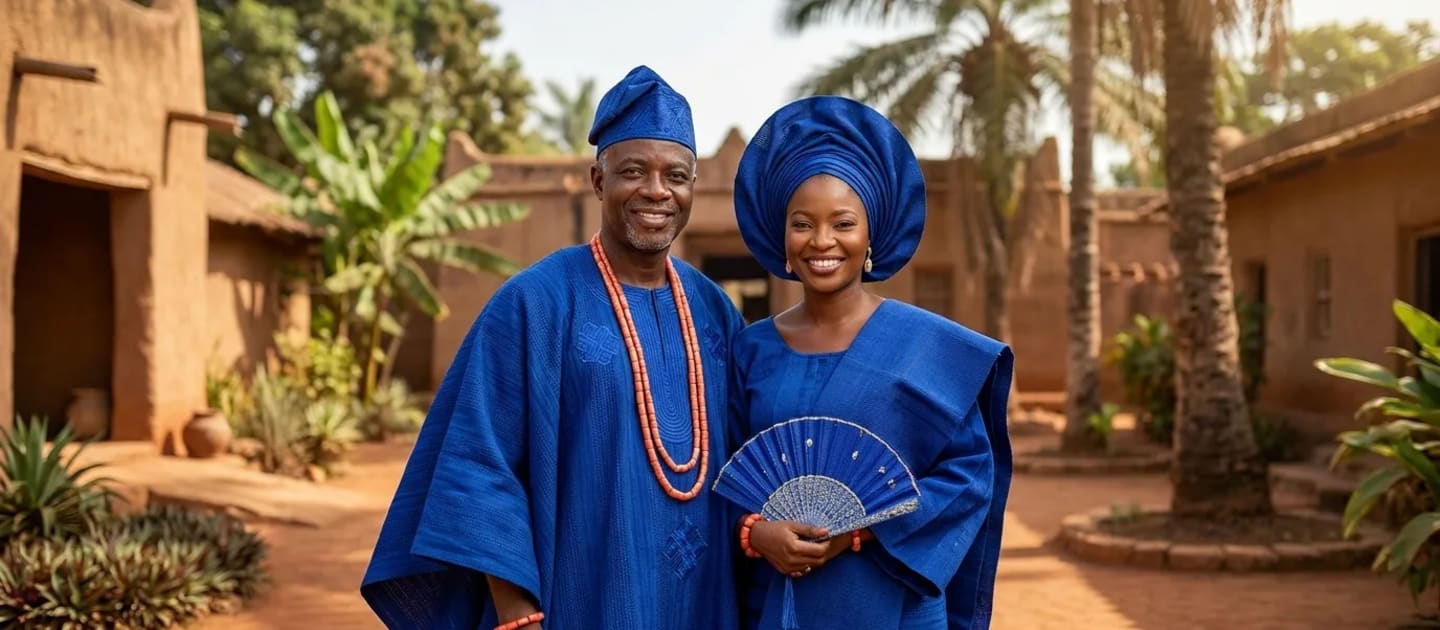
Overview
The Yoruba are concentrated in south western Nigeria, across Lagos, Ogun, Oyo, Osun, Ondo and Ekiti, with large populations in Kwara and Kogi and related communities in Benin Republic and Togo. They are one of the most urbanised peoples in Africa, with towns such as Ibadan, Abeokuta, Ile-Ife, Oyo and Ogbomoso that were already large and densely built long before colonial rule. Yoruba political tradition is monarchical: each town has an oba supported by a council of chiefs, and Ile-Ife holds the place of origin in Yoruba thought, while the Alaafin of Oyo once headed an empire that stretched west into present-day Benin.
Yoruba religion, philosophy and art have travelled further than the people themselves. The òrìṣà tradition, the Ifá divination corpus and the drumming and dance that accompany them survive in Cuba, Brazil and Trinidad through the Atlantic slave trade, where they shaped Santería and Candomblé. Today most Yoruba are Muslim or Christian, often within families that hold both, and older practice persists alongside them. The language is tonal, written in a Latin alphabet with diacritics, and carries a proverb-heavy register in which indirect speech and respect for age are woven into ordinary conversation.
Origins and history
Oral tradition holds that Odùduwà descended at Ilé-Ifẹ̀ and founded the Yoruba royal line, from which the ruling houses of the other Yoruba kingdoms trace their sceptres (aṣẹ) by dispersal of his sons and grandsons. Ilé-Ifẹ̀ is regarded by Yoruba tradition as the cradle of the world and of humankind. Historians and archaeologists treat this as a foundation myth expressing real historical processes — the consolidation of Ifẹ̀ as a religious and artistic centre by around the eleventh to fifteenth centuries, evidenced by its celebrated bronze and terracotta heads — while noting that Yoruba-speaking communities and their political structures likely developed over a longer and more gradual period than the Odùduwà narrative suggests. From Ifẹ̀, the Ọ̀yọ́ Empire grew from the fifteenth century into the most powerful Yoruba state, built partly on cavalry and control of northern trade routes, and dominated much of Yorubaland and beyond until its collapse in the early nineteenth century amid civil wars, Fulani pressure from the north and the rise of new towns such as Ibadan and Abeokuta founded by refugees from that collapse.
Social structure
Yoruba society is organised around the ìdílé (extended family/lineage), the ìlú (town) and the oba's palace. Each town is headed by an oba, a hereditary or selected monarch drawn from a ruling ruling house and installed with the backing of kingmaker chiefs; some obas, such as the Ọọ̀ni of Ifẹ̀ and the Aláàfin of Ọ̀yọ́, carry historic seniority recognised across Yorubaland without any one of them ruling the others. Below the oba sit title-holding chiefs, guild heads and, in many towns, powerful women's associations led by the Ìyálóde. Yoruba subgroups are distinct and often proud of local identity: Ọ̀yọ́, Ẹ̀gbá, Ìjẹ̀bú, Ifẹ̀, Ìjẹ̀ṣà, Èkìtì, Òǹdó, Àwórì, Ìgbómìnà and Òkun among them, each with its own dialect and historical kingdom.
Traditional religion
Yoruba traditional religion centres on Olódùmarè, the supreme being, and a large pantheon of òrìṣà such as Ṣàngó, Ògún, Ọya, Ọ̀ṣun and Ọbàtálá, each linked to natural forces, towns and lineages. Ifá divination, interpreted by trained babaláwo priests through the Odù corpus of verses, remains widely consulted for guidance even by many who are otherwise practising Muslims or Christians. Annual festivals such as the Ọ̀ṣun-Òṣogbo and Ẹ̀yọ́ festivals continue to draw large crowds, and òrìṣà worship is actively practised today, not merely remembered, in Nigeria and among diaspora communities that maintain it in Cuban Santería and Brazilian Candomblé.
Notable customs
Marriage traditionally proceeds through formal introduction, payment of a bride price and an ẹ̀ìgbéyàwó ceremony marked by praise-singing, dance and lavish dress in aṣọ ẹbí (family uniform fabric). Naming ceremonies take place on the seventh, eighth or ninth day after birth, when the child is given several names reflecting family history and circumstances of birth. Ẹgúngún masquerades honour ancestors, gèlè head-ties and adire dyed cloth mark Yoruba dress, and pounded yam, àmàlà, and ẹ̀gúsí or ẹ̀fọ́ soups are everyday staples.
Greetings
| Phrase | English | Pronunciation |
|---|---|---|
| Ẹ káàrọ̀ | Good morning | eh kaa-raw |
| Ẹ kú ìrọ̀lẹ́ | Good evening | eh koo ee-raw-leh |
| Ṣé àlàáfíà ni? | Are you well? | sheh ah-laa-fee-ah nee |
| Ẹ ṣé | Thank you | eh sheh |
| Ó dàbọ̀ | Goodbye | oh dah-baw |
Where they live
Language
Niger-Congo › Atlantic-Congo › Volta-Niger (Yoruboid)
estimated at around 40 million speakers, with figures ranging higher when second-language speakers across West Africa and the diaspora are included
| Phrase | English | Pronunciation |
|---|---|---|
| Ẹ n lẹ | Hello / Well done (general greeting) | eh n-leh |
| Ẹ káàrọ̀ | Good morning | eh kah-ah-roh |
| Ẹ káàsán | Good afternoon | eh kah-ah-sahn |
| Ẹ kúùrọ̀lẹ́ | Good evening | eh koo-oo-roh-leh |
| Ẹ ṣé | Thank you | eh sheh |
| Jọ̀wọ́ | Please | joh-woh |
Their food
- side
Adalu
Beans and sweet corn cooked together until both are soft, finished with palm oil, pepper and onions. The corn keeps a slight bite and sweetness against the soft beans.
- snack
Akara
Peeled beans ground to a paste, whipped with onion and pepper until light, then deep fried in spoonfuls until crisp outside and airy inside. Known as kosai in Hausa and akara in Yoruba and Igbo.
- swallow
Amala
A dark brown swallow made by stirring yam flour into boiling water until smooth. The colour comes from the drying and roasting of the yam before it is milled, not from any added ingredient. A pale variant, amala lafun, is made from cassava flour.
- swallow
Amala Isu
The yam version of amala, made from elubo, yam that has been peeled, sliced, dried and milled. It is dark brown and smoother and more elastic than the cassava version, and is what most people mean when they say amala.
- swallow
Amala Lafun
The pale variant of amala, made from lafun, which is cassava that has been fermented, dried and milled into flour. It is off-white to light brown, softer than yam amala and slightly sour from the fermentation.
- side
Asaro
A soft, thick porridge made from chunks of yam cooked down in a palm oil–based sauce with peppers, onions and seasonings until the yam breaks down slightly and thickens the mixture. It has a warm orange colour and a comforting, mildly spicy taste.
Their festivals
- Festival
Egungun
varies by town, with each community's traditional council setting its own annual dates
- Festival
Eyo Festival
Irregular. It is declared for a specific occasion, usually the final burial rites of a Lagos oba or a senior chief, and announced weeks in advance.
- Festival
Lisabi
held annually, usually around September; the exact date is set by the Egba traditional council each year
- Festival
Ogun Festival
observed annually by individual towns, each setting its own date through local tradition; Ire-Ekiti and Ondo hold their own separate Ogun festivals rather than a single shared date
- Festival
Ojude Oba
the third day after the Ileya (Eid el-Kabir) holiday, so the date moves each year with the Islamic calendar
- Festival
Olojo
held annually in the Yoruba traditional calendar, usually falling around October; the date is fixed by the Ife traditional council and Ifa priests each year and shifts accordingly
Culture and custom
- Culture
Àdìrẹ and Nigerian Textile Craft
Àdìrẹ is Yorùbá indigo resist-dyed cloth made by women in Abeokuta and Ibadan, a craft that nearly died under imported prints and is now reviving.
- Culture
Ifá and Yorùbá divination
Ifá divination, guided by the deity Ọ̀rúnmìlà and interpreted by trained babaláwo through the odù corpus, remains a living Yorùbá practice recognised by UNESCO.
- Culture
Talking Drums and Drum Language
The Yorùbá dùndún drum reproduces the tones of speech itself, letting skilled drummers recite praise poetry and greetings that listeners can follow as if spoken.
Neighbouring and related peoples
Next from the Yoruba: hear the language in Yorùbá, eat your way through Adalu, or or see Egungun.
Spotted something wrong? Tell us.