
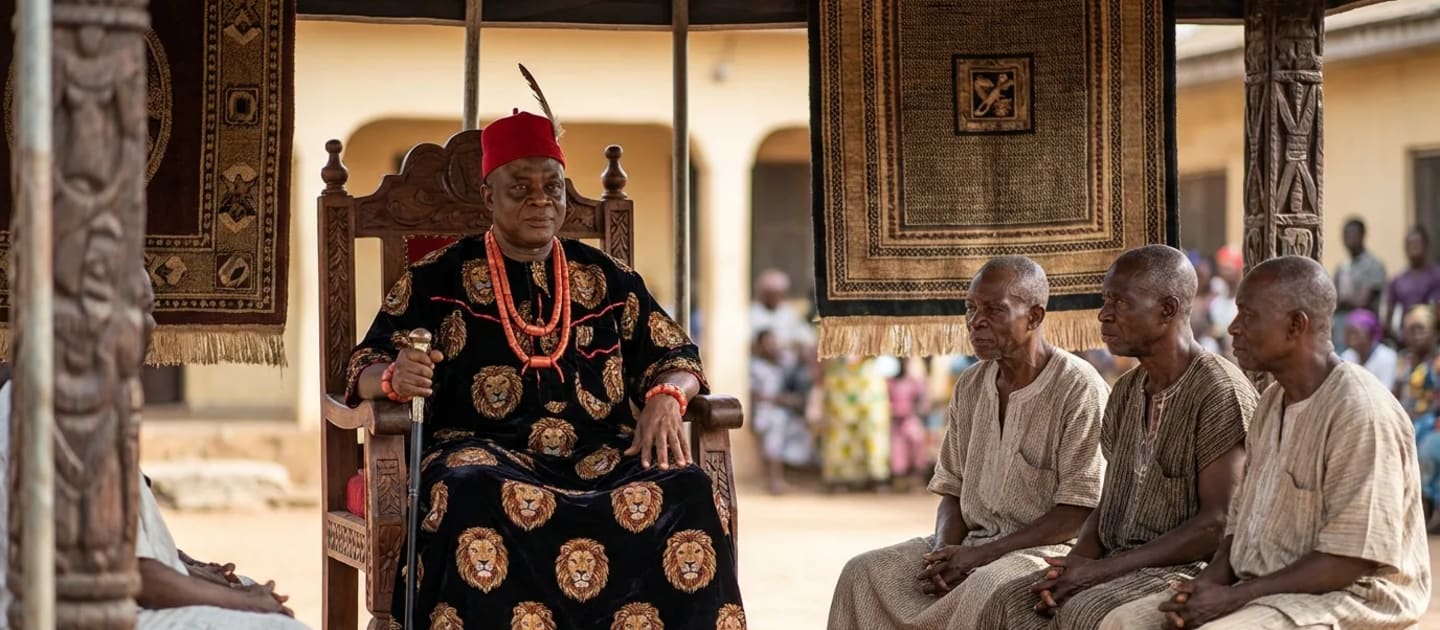
Hereditary stools versus honorary titles
Nigeria's chieftaincy landscape holds two quite different kinds of title, and confusing them is a common source of misunderstanding. The first is the hereditary or customary stool: a traditional ruler's office, tied to a specific throne, town or kingdom, filled according to established custom from within a ruling family or lineage, and carrying real, if now legally limited, customary authority over a defined community. The second is the honorary or conferred chieftaincy title, given by a traditional ruler (or, in some cases, by a community or professional association acting through a ruler) to an individual in recognition of achievement, service or, frequently, financial contribution, and carrying prestige and a title of address without inherited succession or governing authority attached to it. A great many prominent Nigerians in business, politics and entertainment hold honorary chieftaincy titles of this second kind, sometimes several from different towns.
The major hereditary offices
Distinct titles attach to distinct kingdoms and peoples, and are not interchangeable:
- Ọba — the standard Yorùbá term for a king, used across the many Yorùbá kingdoms (Ọba of Lagos, Ọọ̀ni of Ifẹ̀, Aláàfin of Ọ̀yọ́, and others), and also the title of the traditional ruler of the Edo people, the Ọba of Benin, whose palace and office are central to Benin's own royal history.
- Emir — the title used across the Hausa-Fulani emirates of northern Nigeria, established or reorganised in their present form substantially following the nineteenth-century Sokoto Caliphate, and today headed collectively, in ceremonial terms, by the Sultan of Sokoto as the most senior traditional Islamic ruler in the north.
- Obi — the title of Igbo traditional rulers, most notably the Obi of Onitsha, though Igbo political tradition historically also included many communities without centralised kingship at all, governed instead through councils of elders, age-grades and title societies (ọzọ and others) rather than a single ruling stool.
- Etsu — the title of the Nupe traditional ruler, the Etsu Nupe, based in Bida.
- Attah — the title of the Igala traditional ruler, the Attah of Igala, based in Idah.
- Amanyanabo — the title used by a number of Ijaw and Niger Delta kingdoms and city-states, such as the Amanyanabo of Bonny and of Okrika, for their traditional rulers.
Other groups use further distinct titles again — the Olu of the Itsekiri, the Ọvie among some Urhobo clans, the Tor Tiv among the Tiv, and many more — reflecting the fact that Nigeria's traditional political systems were never a single uniform structure but a large number of separate kingdoms, chiefdoms and stateless societies that colonial and post-colonial administration later grouped under the single English umbrella term "traditional ruler".
Kingmakers and selection
Filling a hereditary stool is, in the great majority of Nigerian traditions, not a simple matter of the eldest son inheriting automatically. Instead a body of kingmakers — senior chiefs, ruling-house heads or title-holders specific to that kingdom's custom — selects a candidate, usually from among eligible members of one or more recognised ruling houses or lineages that rotate or compete for the stool, sometimes after consulting oracles or performing divination as part of confirming a candidate's fitness. This process can be lengthy and, particularly where more than one ruling house has a claim, contested; succession disputes, sometimes ending up in court, are a recurring feature of chieftaincy politics in many Nigerian kingdoms.
Authority under the constitution
Nigeria's 1999 Constitution, like its predecessors since independence, does not grant traditional rulers formal executive, legislative or judicial power in the modern state structure; there is no constitutional "third tier" for traditional authority alongside federal, state and local government. Traditional rulers' actual influence today rests instead on customary and religious authority recognised by their own communities, on their statutory role advising state governments through Councils of Traditional Rulers or Obas' and Chiefs' Councils (bodies whose exact powers and recognition vary by state), on their role in conflict resolution, land matters and customary law at the community level, and, very substantially, on their social and political influence as respected figures whom state and federal politicians court for endorsement and community mobilisation. Colonial-era "indirect rule", which governed through recognised chiefs, particularly in the north, entrenched much of this influence and shaped how these offices function within the modern state, even though the formal legal power of the colonial chief has since been stripped away.
Titles sold for money and influence
The conferring of honorary chieftaincy titles has drawn persistent and open criticism within Nigeria, particularly where titles are seen to be given in direct or indirect exchange for large financial "donations" to a traditional ruler, a palace, or a community development project, rather than for any genuine service or standing. Critics, including commentators, clergy and some traditional rulers themselves, argue that this practice cheapens genuinely earned titles, allows individuals of poor reputation, including some facing corruption or criminal allegations, to purchase respectability and a public platform, and turns chieftaincy institutions into a revenue stream rather than a custodian of custom and community leadership. Defenders point out that honorary titles have always in part functioned as a way for traditional institutions, which typically receive no direct state funding for their palaces and obligations, to raise money for community projects, and that the practice is old and widespread enough to be, in effect, an accepted part of how many chieftaincy institutions now sustain themselves financially. The tension between these two views remains unresolved and recurs whenever a controversial figure is publicly given a prominent chieftaincy title.
Last verified 13 September 2026
Spotted something wrong? Tell us.